This is a brief overview of some of the most noteworthy firsts and significant events in college football. The sport celebrated its 150th anniversary in 2019. The TL/DR version comes first:
- In 1869, Rutgers University and the college of New Jersey (now Princeton University) played the first college football game.
- Representatives from Columbia, Harvard, Princeton, and Yale drafted the first college football rules on November 23, 1876, in Springfield, Massachusetts.
- On October 8, 1921, West Virginia University vs. Pittsburgh University was the first collegiate football game to be televised. It was carried by Pittsburgh radio station KDKA-AM.
- On September 30, 1939, Fordham University and Waynesburg University played the first collegiate football game shown on television. W2XBS carried the NBC coverage of the game.
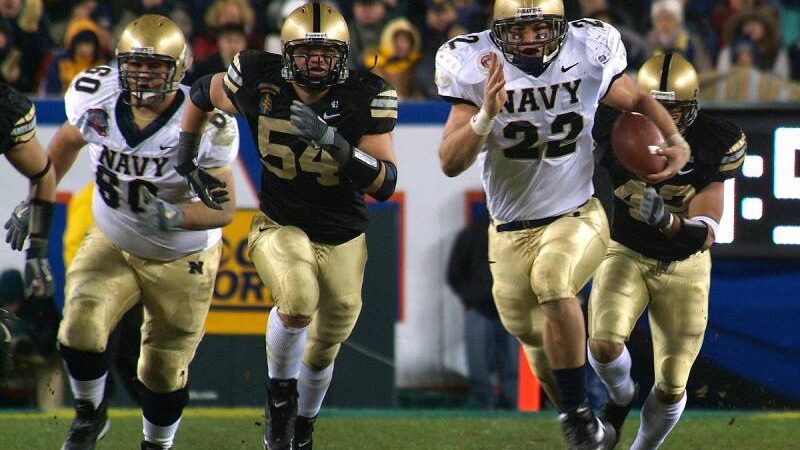
- On December 7, 1963, during an Army vs. Navy college football game, instant replay was used for the first time.
- In 1939, the first Associated Press poll was published, marking the beginning of college football rankings. The College Football Playoff (CFP) rankings, which began in 2014, and the Bowl Championship Series (BCS) rankings, which began in 1998, are two more noteworthy rating systems.
- In 1935, Chicago University’s Jay Berwanger received the first Heisman Trophy. The New York Downtown Athletic Club developed the prize.
- The University of Michigan is the college football team with the most victories in history. Since their inaugural campaign in 1879, the Wolverines have accumulated 1,011 wins.
- With 18 titles, Yale holds the record for most collegiate football championships. With 16 titles, Alabama is in second place.
When was the first college football game?
American football began on College Avenue in New Brunswick, New Jersey, in 1869. The College of New Jersey, which is now Princeton University, played Rutgers University.
Both teams had 25 players on the pitch, and the London Football Association’s regulations prohibited players from throwing or picking up the ball. If seen in the context of modern football, the game would appear to be one long fumble in which participants attempted to kick or smash the ball past the goal line of the opposing team. It was similar to a version of rugby or soccer.
Rutgers beat them 6-4 in the match, which drew about 100 spectators.
When did the first set of rules get established?
Representatives from Columbia, Harvard, Princeton, and Yale convened to create the initial rules of what is now known as American football just seven years after the first game was played.
The representatives convened on November 23, 1876, at Massasoit House in Springfield, Massachusetts. Walter Camp became known as the “father of American football” at this point. The line of scrimmage, the center-to-quarterback snap, the downs system, and the suggestion that each side should have no more than 11 players on the field are all rules that Camp established and that viewers are now familiar with.
When was the first college football game on radio?
West Virginia University vs. Pittsburgh University, one of the inaugural rounds of the “Backyard Brawl,” was broadcast on television for the first time on October 8, 1921. Pittsburgh’s KDKA-AM, the nation’s first commercial radio station, carried the game. Pittsburgh won 21–13.
When did college football get its first television broadcast?
When Fordham hosted Waynesburg for a season opening on September 30, 1939, it was the first game to be broadcast on television. NBC televised the game on W2XBS. At the time, Fordham, a dominant football program, prevailed 34–7. It was estimated that between 500 and 5,000 people watched.
When was instant replay first replay?
On December 7, 1963, during an Army vs. Navy game, instant replay was first shown on television screens. “Ladies and gentlemen, Army did not score again!” said announcer Lindsey Nelson as the production employed a 1,300-pound equipment to wind back the reel and repeat a touchdown.
When did the rankings for college football start?
In 1936, the Associated Press published its inaugural rankings. Twenty teams were included in the rankings, which assisted in identifying the college football champion. As the 1936 college football champions, Minnesota became the first team to finish first in the AP rankings at the end of the season.
1998 saw the creation of the Bowl Championship Series (BCS). At the end of the season, the BCS implemented a system that paired the top 10 teams in prestigious bowl games, which included pairing the top two teams in a BCS national championship game. Tennessee defeated Florida State 23–16 in the first BCS national championship game.
The 2014 season saw the start of the College Football Playoff era. Four teams were chosen to compete in the playoffs for the first ten years, which included two semifinal matches and a national championship match. The 2024–25 season marked the introduction of a new extended format.
- Twelve teams will be chosen to compete in the playoffs, with automatic invitations going to the top five conference winners.
- The top four playoff spots and a first-round bye will go to the top four-ranked teams, regardless of whether they are conference champions.
- The top four conference winners were seeded 1-4 in the first-ever 12-team playoff in 2024, and each will receive a first-round bye.
- The higher-ranked team’s home ground will host the first round matchup against teams seeded 5–12.
Cotton, Fiesta, Orange, Peach, Rose, and Sugar are the six bowls that alternate between the quarterfinals and semifinals. The national title game will take place on a Monday night at least a week after the semifinals, which will take place around the New Year’s holiday. When four teams qualified for the 2014 College Football Playoffs, Ohio State became the first to win.
When was the first Heisman Trophy awarded?
The first Heisman Trophy was given to Jay Berwanger of Chicago University by members of the Downtown Athletic Club (DAC) in New York in 1935. In 1936, the trophy was renamed in honor of John W. Heisman. Archie Griffin, a running back for Ohio State, became the first and only athlete to win the Heisman Trophy in back-to-back seasons on December 2, 1975.
Heisman Trophy winners: History
| YEAR | WINNER | SCHOOL | POSITION |
|---|---|---|---|
| 2024 | Travis Hunter | Colorado | CB/WR |
| 2023 | Jayden Daniels | LSU | QB |
| 2022 | Caleb Williams | Southern Cal | QB |
| 2021 | Bryce Young | Alabama | QB |
| 2020 | Devonta Smith | Alabama | WR |
| 2019 | Joe Burrow | LSU | QB |
| 2018 | Kyler Murray | Oklahoma | QB |
| 2017 | Baker Mayfield | Oklahoma | QB |
| 2016 | Lamar Jackson | Louisville | QB |
| 2015 | Derrick Henry | Alabama | RB |
| 2014 | Marcus Mariota | Oregon | QB |
| 2013 | Jameis Winston | Florida State | QB |
| 2012 | Johnny Manziel | Texas A&M | QB |
| 2011 | Robert Griffin III | Baylor | QB |
| 2010 | Cam Newton | Auburn | QB |
| 2009 | Mark Ingram Jr. | Alabama | RB |
| 2008 | Sam Bradford | Oklahoma | QB |
| 2007 | Tim Tebow | Florida | QB |
| 2006 | Troy Smith | Ohio State | QB |
| 2005 | Reggie Bush* | Southern California | RB |
| 2004 | Matt Leinart | Southern California | QB |
| 2003 | Jason White | Oklahoma | QB |
| 2002 | Carson Palmer | Southern California | QB |
| 2001 | Eric Crouch | Nebraska | QB |
| 2000 | Chris Weinke | Florida State | QB |
| 1999 | Ron Dayne | Wisconsin | RB |
| 1998 | Ricky Williams | Texas | RB |
| 1997 | Charles Woodson | Michigan | CB/returner |
| 1996 | Danny Wuerffel | Florida | QB |
| 1995 | Eddie George | Ohio State | RB |
| 1994 | Rashaan Salaam | Colorado | RB |
| 1993 | Charlie Ward | Florida State | QB |
| 1992 | Gino Torretta | Miami | QB |
| 1991 | Desmond Howard | Michigan | WR/returner |
| 1990 | Ty Detmer | BYU | QB |
| 1989 | Andre Ware | Houston | QB |
| 1988 | Barry Sanders | Oklahoma State | RB |
| 1987 | Tim Brown | Notre Dame | WR |
| 1986 | Vinny Testaverde | Miami | QB |
| 1985 | Bo Jackson | Auburn | RB |
| 1984 | Doug Flutie | Boston College | QB |
| 1983 | Mike Rozier | Nebraska | RB |
| 1982 | Herschel Walker | Georgia | RB |
| 1981 | Marcus Allen | Southern California | RB |
| 1980 | George Rogers | South Carolina | RB |
| 1979 | Charles White | Southern California | RB |
| 1978 | Billy Sims | Oklahoma | RB |
| 1977 | Earl Campbell | Texas | RB |
| 1976 | Tony Dorsett | Pitt | RB |
| 1975 | Archie Griffin | Ohio State | RB |
| 1974 | Archie Griffin | Ohio State | RB |
| 1973 | John Cappelletti | Penn State | RB |
| 1972 | Johnny Rodgers | Nebraska | WR/RB |
| 1971 | Patt Sullivan | Auburn | QB |
| 1970 | Jim Plunkett | Stanford | QB |
| 1969 | Steve Owens | Oklahoma | FB |
| 1968 | O.J. Simpson | Southern California | HB |
| 1967 | Gary Beban | UCLA | QB |
| 1966 | Steve Spurrier | Florida | QB |
| 1965 | Mike Garrett | Southern California | HB |
| 1964 | John Huarte | Notre Dame | QB |
| 1963 | Roger Staubach | Navy | QB |
| 1962 | Terry Baker | Oregon State | QB |
| 1961 | Ernie Davis | Syracuse | HB/LB/FB |
| 1960 | Joe Bellino | Navy | HB |
| 1959 | Billy Cannon | LSU | HB |
| 1958 | Pete Dawkins | Army | HB |
| 1957 | John David Crow | Texas A&M | HB |
| 1956 | Paul Hornung | Notre Dame | QB |
| 1955 | Howard Cassady | Ohio State | HB |
| 1954 | Alan Ameche | Wisconsin | FB |
| 1953 | Johnny Lattner | Notre Dame | HB |
| 1952 | Billy Vessels | Oklahoma | HB |
| 1951 | Dick Kazmaier | Princeton | HB |
| 1950 | Vic Janowicz | Ohio State | HB/P |
| 1949 | Leon Hart | Notre Dame | End |
| 1948 | Doak Walker | SMU | HB |
| 1947 | Johnny Lujack | Notre Dame | QB |
| 1946 | Glenn Davis | Army | HB |
| 1945 | Doc Blanchard | Army | FB |
| 1944 | Les Horvath | Ohio State | QB/HB |
| 1943 | Angelo Bertelli | Notre Dame | QB |
| 1942 | Frank Sinkwich | Georgia | HB |
| 1941 | Bruce Smith | Minnesota | HB |
| 1940 | Tom Harmon | Michigan | HB |
| 1939 | Nile Kinnick | Iowa | HB/QB |
| 1938 | Davey O’Brien | TCU | QB |
| 1937 | Clint Frank | Yale | HB |
| 1936 | Larry Kelley | Yale | End |
| 1935 | Jay Berwanger | Chicago | HB |
*Vacated
In the history of college football, who has won the most games?
Despite the fact that Rutgers and Princeton were the pioneers of college football, a Midwest team has won the most games. With 1,011 victories, Michigan tops all collegiate football teams.
Yale is at the top of the list with the most National Championships, followed by Princeton and Alabama.
| School | Number of titles |
|---|---|
| Yale | 18 |
| Alabama | 16 |
| Princeton | 15 |
| Notre Dame | 13 |
| Michigan | 9 |
| Southern Cal | 9 |
| Ohio State | 9 |
| Harvard | 8 |
| Oklahoma | 7 |
| Minnesota | 6 |
Other significant turning points in college football
The first African American football player to play in a Rose Bowl was Fritz Pollard in 1916. In 1921, when player-coaches were still in use, Pollard became the first African American to be hired as an NFL head coach. In 1923, he became the first African American to play quarterback in the NFL, continuing his football-filled life.
Georgia Tech made college football history on October 7, 1916, when they defeated Cumberland college by an overwhelming 222-0. With Cumberland committing 15 turnovers and Georgia Tech scoring 32 touchdowns, this blowout is unmatched by any previous game.
The NCAA adopted a regulation permitting two-point conversions in 1958. In an effort to balance offensive and defensive play and try to boost scoring, the regulation was implemented. During that first season, the post-touchdown technique was attempted 51.4% of the time.
The 1966 season’s winner was decided by the historic 10-10 tie between No. 1 Notre Dame and No. 2 Michigan State in a game played at the end of the season. Even though Notre Dame held the ball and the score was at 10–10, coach Ara Parseghian chose to let the clock run from 1:10 to zero in what is regarded as one of the most contentious games in college football history. Following the game, Notre Dame defeated Southern California to end the season 9-0-1 and win the NCAA championship, according to most polls.
Two place-kickers became the first two female scorers in a collegiate football game in the late 1990s and early 2000s. In 1997, Williamette’s Liz Heaston successfully kicked two extra points for her team. Previously an NAIA school, Williamette is currently a Division III institution. Ashley Martin became the first female scorer in a Division I college football game in 2001 when she kicked three extra points for Jacksonville State.

- NCAA Announces First Coaches’ Rankings Ahead of 2026 DI Wrestling Championships - January 30, 2026
- Hilton Grand Vacations Tournament of Champions 2026: TV Schedule, Purse, Celebrity Field & How to Watch - January 30, 2026
- NCAA Drops Official 2027 Women’s Final Four Logo for Columbus Event - January 30, 2026