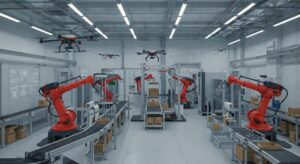
The manufacturing sector is an engine fueling the world’s economy, where automation is key. The International Federation of Robotics stated that in 2023 more than 3 million industrial robots were working in the global world, which by annual forecasts, is predicted to increase 7% year over year, as industries target efficiency and precision. From food processing to electric vehicles, automation is revolutionizing the way products are made, addressing increasing costs, shortages of labor, and calls for sustainability. But this change isn’t without its challenges, and it’s the creativity of engineers that keeps the gears rolling.
Enter an experienced mechanical engineer, Sriharish Muralidhar, with more than seven years of experience, a master’s in industrial engineering, and an inclination for tackling real-world issues. From a background that combines technical smartness with hands-on management, this professional has made a name in manufacturing and quality control. With emphasis on new product launches, lean manufacturing, and continuous improvement, his career is a testament to a never-ending pursuit of process optimization and results,a philosophy forged through years of working on high-risk projects in fast-paced, dynamic environments.
Manufacturing today is confronted with a set of urgent challenges: cost pressures, quality requirements, and scalability. Increasing labor costs and shortages compel businesses to reconsider manual processes, while customers demand perfect products delivered quicker than ever before. Scaling production without sacrificing quality or bursting budgets is a balancing act, particularly in sectors such as agriculture, public safety, and consumer goods. Old-school approaches that consider manual checks or fragmented automation are likely to fall short, resulting in lags in efficiency and dependability that affect supply chains.
The sector has relied heavily on robotic arms, simple vision systems, and lean techniques to cure these ills. Robot arms perform repetitive functions, and 2D vision systems detect surface flaws. Lean reduces waste, and programmable logic controllers (PLCs) keep it integrated. Yet these remedies have their limitations. Basic vision can’t measure volume or depth, and off-the-shelf automation struggles with customized needs like ensuring a seedling thrives or a safety device deploys perfectly every time. The field craved a leap forward, something tailored yet scalable.
Sriharish’s approach stands out for its fusion of cutting-edge technology and practical problem-solving. Take the challenge of inspecting tiny explosive components critical to a safety device’s range and reliability. Where checks by hand once ruled, he brought in a 3D vision system with a structured light snapshot sensor that scans in seconds, measuring volume and detecting voids with accuracy. “It wasn’t so much about replacing hands with machines,” he looks back. “It was about establishing trust in each unit that goes off the line.” Elsewhere, he confronted indoor agriculture by creating a system to transport thousands of seedlings per day through stages of growth, combining cranes, sensors, and RFID tags into an effortless ballet of automation. These were not simply enhancements; they were redesigns, merging mechanical design, vision technology, and PLC expertise to satisfy special requirements.
His work extends beyond conventional engineering. He acts as a connection between concept and implementation, guiding teams through design, vendor integration, and commissioning. Whether modernizing a production line or introducing a new one, he makes systems not only work but excel. His skill in root cause analysis and continuous improvement has reduced downtime by a third and increased output, and his leadership in new product introductions has transformed prototypes into marketplace successes. Throughout the industries, his knowledge of automation and quality assurance has set a template for productivity, showing the world that innovation flourishes at the point of intersection of science and practicality.
The numbers speak eloquently: $30,000 in savings from one adjustment in a process, $800,000 annually in gains from overall improvements, and a nursery line processing 276,000 plants a day. Product loss fell from 40% to 17%, test times decreased by more than a third, and equipment efficiency reached 80%. These aren’t statistics; their lives are touched by consistent safety equipment, communities nourished by sustainable crops, and companies thriving on streamlined operations. His single publication on machine vision systems, delving into AI and deep learning, has guided his work, extending its impact. “Automation isn’t the end, it’s the tool to make things better for humans,” he responds, showing the people’s side of his technical achievements.
His abilities considering vision system deployment, robotic programming, and statistical analysis are unique. They’ve attracted interest from leading companies in electric vehicles, warehouse logistics, and medical devices, indicating his impact across any one industry. Signature projects, such as automating a high-risk inspection or directing a cultivation system from the ground up, demonstrate his talent for addressing specialized issues with generalized solutions. The transformative power of engineering innovation can lead to tangible, real-world benefits. For instance, a single engineer’s vision can enhance safety, promote sustainable agriculture, and strengthen supply chain resilience, ultimately revolutionizing an entire industry.