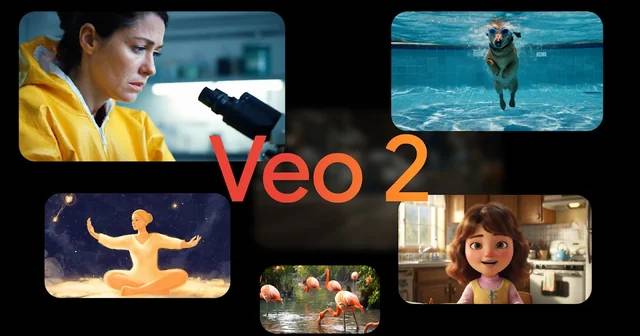
Google has revealed that Gemini will soon get yet another AI model, but this one goes beyond a chatbot. With the launch of the Veo 2 video generator on the Gemini app and website, paid users will have the opportunity to create short video clips using Google’s allegedly innovative video model.
Veo works similarly to previous video generators, such as OpenAI’s Sora, in that you submit text that describes the film you want, and a Google data center will process tokens until the desired animation is generated. According to Google, Veo 2 was created with a strong understanding of real-world physics, including human movement. The samples from Google do appear to be good, but that’s probably why they were chosen.
The model drop-down will offer Veo 2, but Google says it’s still figuring out how to incorporate this feature, so the location may change. It isn’t there yet, though, most likely. Veo 2 may not be available to all Gemini Advanced users for some weeks, despite Google beginning rolling out today. For most users, Gemini features can take a shockingly long time to appear. For instance, Google took over a month to make Gemini Live video available to everyone after announcing its release.
When Veo 2 appears in your Gemini app, you’ll have the ability to customize your video creation with detailed instructions, offering greater control over the final output. Currently, Veo 2 supports up to 8 seconds of video at 720p resolution, which can be saved in standard MP4 format for easy sharing or editing.
Due to the high resource demands of video processing, Google has introduced a monthly usage cap for this feature. While the exact limit hasn’t been disclosed, users will receive notifications as they near their allocation.
If you’d prefer not to wait for Veo 2 to roll out in the Gemini app, there’s another way to explore its capabilities. The tool is now integrated into Whisk, a Google Labs project introduced in late 2024. Whisk enables users to generate visuals using both written prompts and reference images.
As of today, Whisk includes a new “animate” feature that allows you to convert static images into short video clips—up to 8 seconds—powered by Veo 2. Notably, Google has set a monthly cap of 100 videos within Whisk, which may offer insight into potential usage limits for Veo 2 across other platforms like Gemini.
Even with options to adjust your base image and style, early impressions of Veo 2 suggest that finding the desired result may require multiple attempts—possibly consuming a significant portion of your monthly quota.
The video above was intended to depict a mysterious stone monolith on Mars, and while the rendering itself is fairly well-executed, the request for the Martian moon Phobos to collide with and destroy the monolith didn’t quite land. Instead of a realistic impact, the moon simply bounces past and vanishes—leaving the monolith untouched. It’s clear that Veo 2 still has some limitations when it comes to simulating real-world physics, especially with large-scale astronomical events.
Google emphasizes that it has taken steps to ensure Veo 2 operates within safe boundaries, avoiding any generation of harmful or illegal content. Each video is tagged with a SynthID digital watermark to clearly indicate that it was AI-generated. While Veo 2 offers visually impressive clips, it’s still a ways off from creating content that could convincingly pass as real footage.

- NCAA Announces First Coaches’ Rankings Ahead of 2026 DI Wrestling Championships - January 30, 2026
- Hilton Grand Vacations Tournament of Champions 2026: TV Schedule, Purse, Celebrity Field & How to Watch - January 30, 2026
- NCAA Drops Official 2027 Women’s Final Four Logo for Columbus Event - January 30, 2026